Jacob Mchangama and Jeff Kosseff argue that protecting free expression—rather than restricting it—is essential to democracy’s survival
April 7, 2026 — NASHVILLE, Tenn. — As governments across the world tighten controls on speech in the name of combating disinformation, hate speech, and political extremism, a new book from leading free speech scholars warns that democracies may be undermining their own foundations.
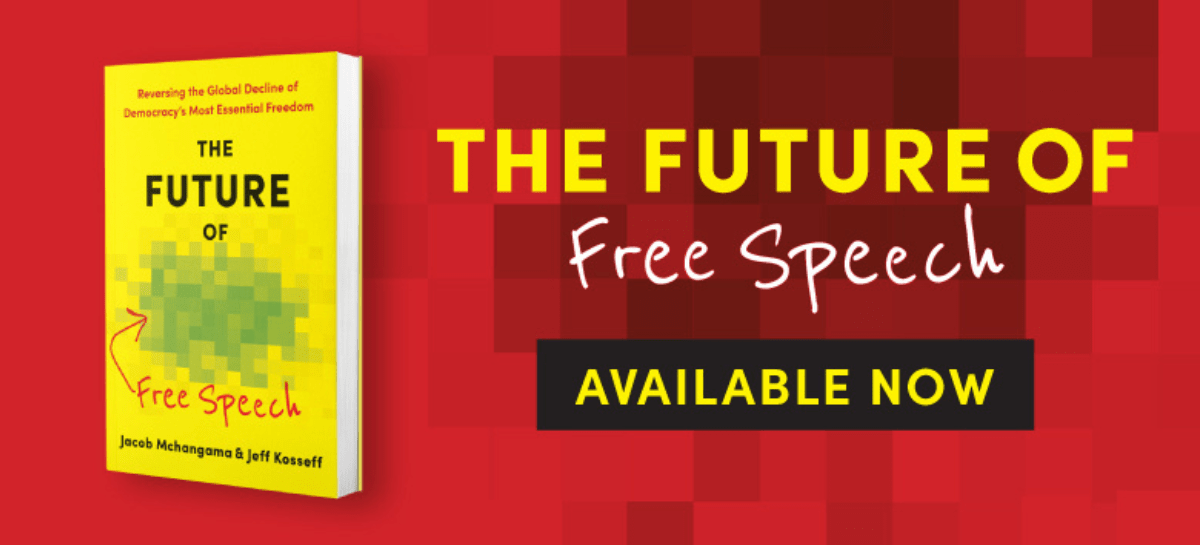
The Future of Free Speech: Reversing the Global Decline of Democracy’s Most Essential Freedom, by Jacob Mchangama and Jeff Kosseff, is now available from Johns Hopkins University Press. The book offers a sweeping global account of what the authors describe as a growing “free speech recession,” alongside a pragmatic roadmap for reversing it without sacrificing democratic values.
Drawing on history, law, and contemporary case studies from democracies and authoritarian states alike, Mchangama and Kosseff argue that censorship—whether imposed by governments or incentivized through regulation of digital platforms—often strengthens the very forces it aims to contain. Rather than calling for new restrictions, the authors emphasize solutions grounded in transparency, decentralization, legal safeguards, and counterspeech.
“Free speech is under increasing siege in today’s world,” said Tyler Cowen of George Mason University. “In their new and important The Future of Free Speech, Jacob Mchangama and Jeff Kosseff advocate for freedom of speech and make a compelling case for optimism.”
The book arrives at a moment when liberal democracies are increasingly willing to police lawful expression, even as authoritarian regimes adopt the language of safety and democracy to justify repression. Mchangama and Kosseff warn that once democracies normalize vague and expansive speech controls, those tools are rarely confined to their original targets.
“A rigorous and inspiring defense of the freedom that safeguards all others,” said Nadine Strossen, former president of the ACLU and professor emerita at New York Law School. “Mchangama and Kosseff powerfully refute alluring but misguided calls for censoring even the most controversial speech… They demonstrate that open debate is essential for protecting human rights and democracy, and resisting authoritarianism.”
Rather than treating free expression as a liability to be managed, The Future of Free Speech presents it as a civic resource—one that enables democratic societies to confront error, extremism, and social conflict without empowering censors.
“The Future of Free Speech is a brilliant defense of our most essential freedom,” said Yascha Mounk of Johns Hopkins University. “A vital roadmap for anyone who recognizes that once we lose the right to speak, we also lose the power to defend every other right.”
The authors also challenge the assumption that restricting speech is an effective response to misinformation and hatred. Drawing on empirical research and comparative legal analysis, they argue that non-coercive approaches—such as counterspeech, institutional restraint, and resilient legal protections—are both more effective and less dangerous in the long run.
The book also tackles the cutting edge of the free-speech debate, examining how artificial intelligence poses a dual threat: as a tool of surveillance and censorship in the hands of authoritarian regimes, and as a new frontier for preemptive content restrictions by governments and corporations in democracies.
“A broad-ranging and powerful analysis… coupled with thoughtful and promising proposals for the future,” said Eugene Volokh of Stanford University and UCLA School of Law. “Very much worth reading.”
Jacob Mchangama is the founder and executive director of The Future of Free Speech and a research professor at Vanderbilt University. Jeff Kosseff is a nonresident senior legal fellow at The Future of Free Speech and the author of Liar in a Crowded Theater. Together, they bring legal, historical, and global perspectives to one of the defining democratic questions of the digital age.
The book’s release will be marked by public events in Washington, D.C., including a launch conversation at Politics & Prose on April 6 and a policy forum at the Cato Institute on April 9.
About The Future of Free Speech
The Future of Free Speech is an independent, nonpartisan think tank located at Vanderbilt University that works to reaffirm freedom of expression as the bedrock of free and thriving societies through actionable research, empowering tools, and principled advocacy. Learn more at www.futurefreespeech.org or follow along on Facebook, X, and LinkedIn.
Contact:
Ajdin Muratovic
Ajdin Muratovic is the Director of Communications at The Future of Free Speech.