As 2025 comes to a close, The Future of Free Speech team wants to thank you for making this year its most productive yet. At a time when both the legal foundations and the culture of free expression face mounting pressure worldwide, your support helped produce timely, independent work that brought much-needed clarity to an increasingly contested landscape.
Download Our 2025 Year In Review
The Global Free Speech Summit
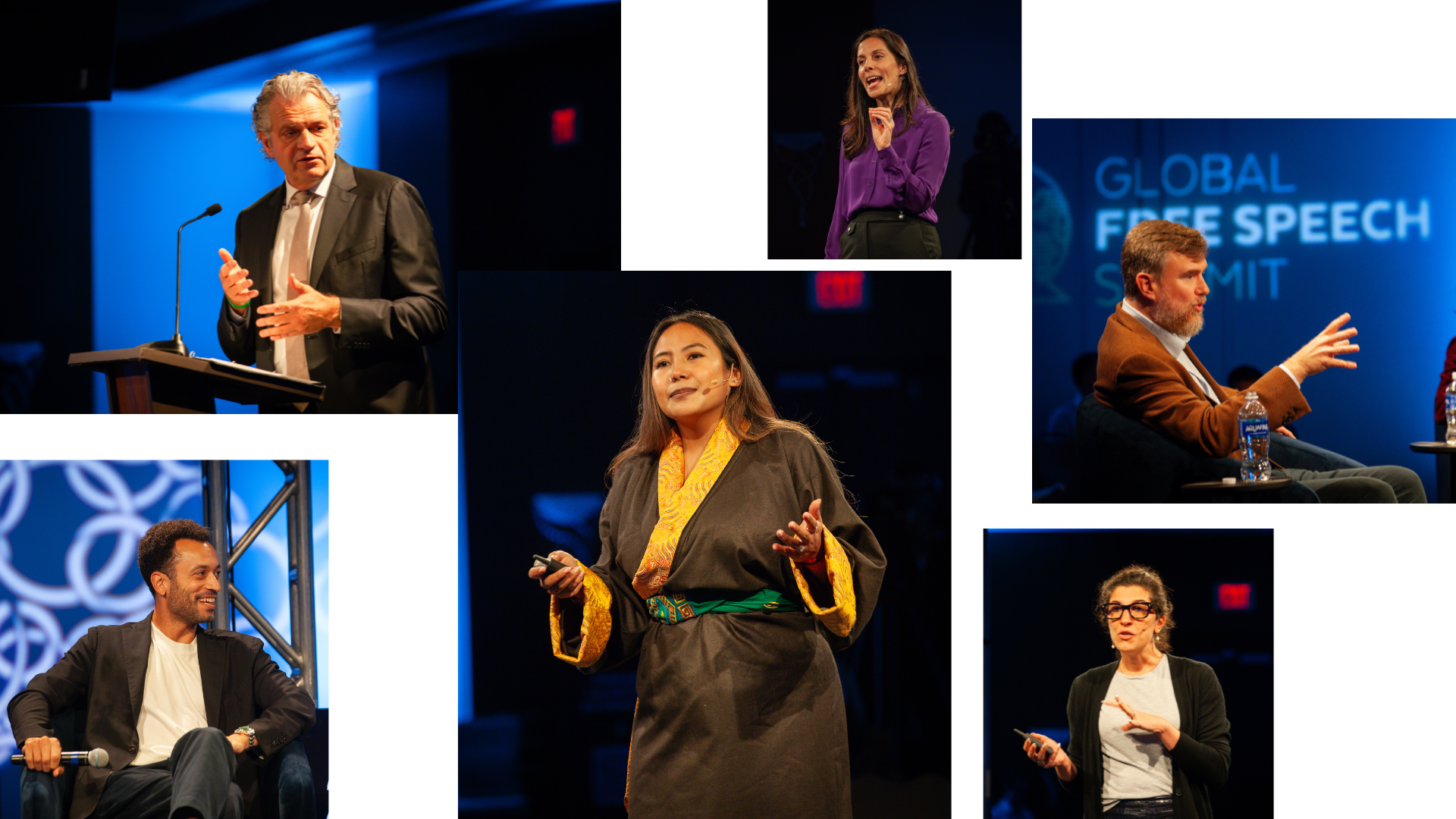
This year, we hosted the second annual Global Free Speech Summit at Vanderbilt University, where leading experts and influential voices from around the world gathered over two days to discuss how free expression can create resilient solutions to today’s most pressing challenges.
Dissidents shared powerful stories about speaking out under oppressive and authoritarian regimes, tech experts and academics explained how to protect free expression in the AI era, and advocates discussed how to promote free speech principles to the next generation.
Impact
In 2025, you helped bring free speech into the spotlight. With your support, we advanced a wide range of research, convenings, and public engagement efforts reaching policymakers, journalists, scholars, and technology leaders around the world.
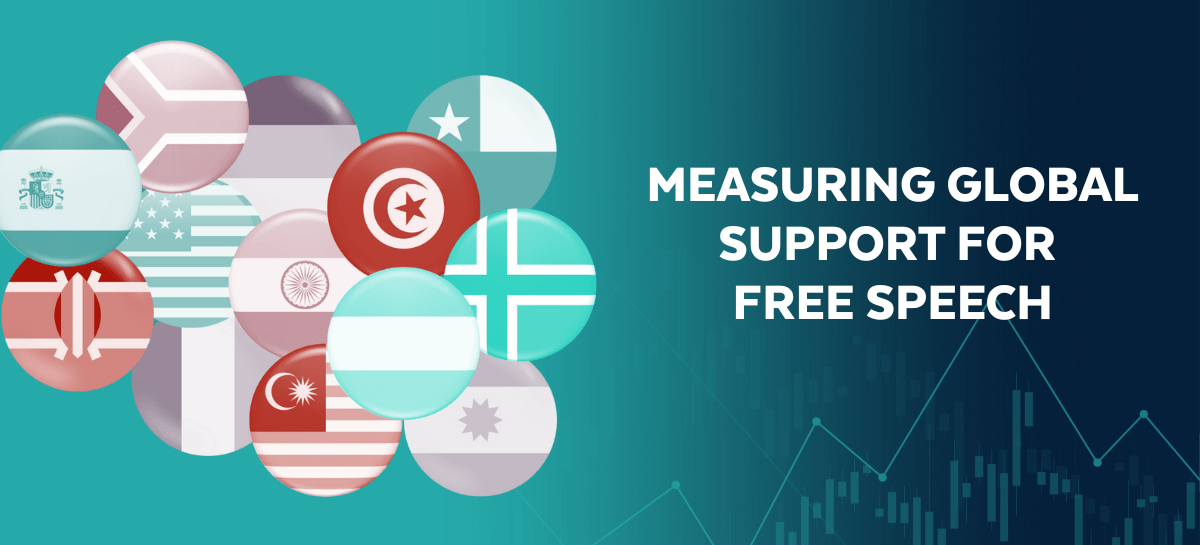
In March, we released “Who in the World Supports Free Speech?”—a global survey of 33 countries that measures public attitudes toward free expression.
Our survey goes beyond abstract support for free speech and asks respondents to test their true commitment to these principles on issues like whether you should be able to criticize the government, insult the national flag, or express support for same-sex relationships.
When it comes to support for free speech, we found a significant decline among Americans. The countries with the highest support included Norway, Denmark, Hungary, Sweden, and Venezuela. In fact, since our last survey in 2021, the U.S. dropped from 3rd to 9th in our ranking!
Overall, much like legal protections for free speech, public support for this fundamental freedom is on a downward trajectory around the world. Since 2021, twice as many countries saw significant declines in support for free expression as gains.
In an essay at The Conversation, Jacob spotlighted the alarming decline in support for free expression among young Americans.
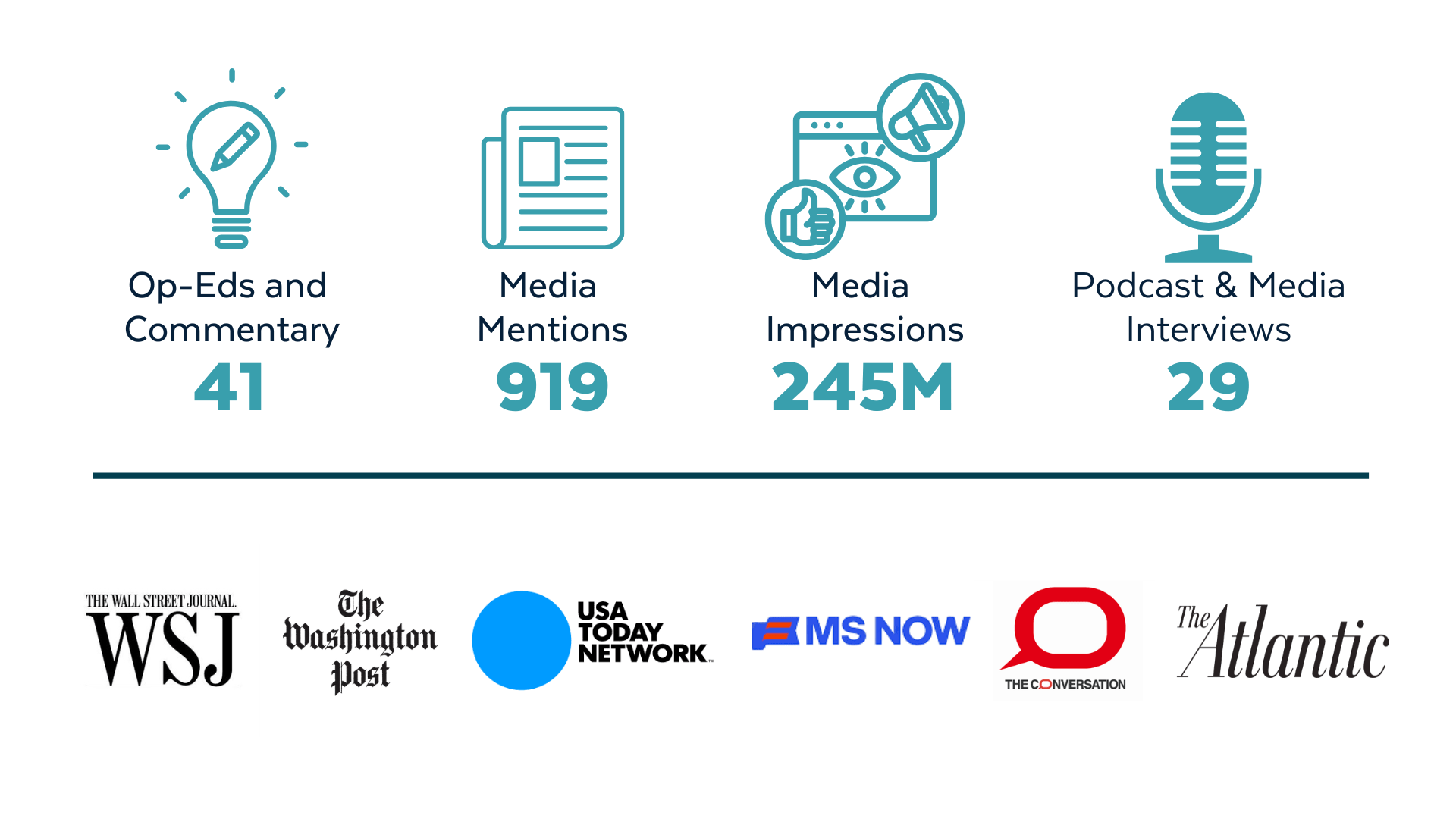
Our research sparked a global discussion. Jacob Mchangama shared our main findings in an interview with CBS News. The report was also featured in The Economist, BBC News, The Tennessean, and Reason, as well as global outlets in India (The Times of India, The Hindu) and the Philippines (Business World). European publications, including Le Point (France), Schweizer Monat (Switzerland), and Berlingske (Denmark), also highlighted findings in their respective regions.
Two decades after the publication of cartoons picturing the Prophet Muhammad in a small Danish newspaper, Europe is still struggling to defend speech that offends.
On the 20th anniversary, Jacob Mchangama reflected in The Globe and Mail, Persuasion, and The Telegraph on the evolution of the “jihadist’s veto”: once enforced through violence, now increasingly embedded in law. From prosecutions of Quran burners to the return of de facto blasphemy rules, Jacob warned that fear of backlash is reshaping the boundaries of lawful expression across Europe.
That broader retreat from free speech has been a central theme of FoFS’s work this year. In an invited essay for the UK Commission for Countering Extremism, Jacob argued that democracies from Britain to France to Germany are trading away the “safety valve” of free expression in the name of security—often creating instability rather than preventing it.
FoFS scholarship has also helped bring these concerns into the mainstream. In The Atlantic, Conor Friedersdorf examined Europe’s expanding criminalization of “offensive” speech, citing Jacob on Germany’s investigations of thousands of citizens for online expression and drawing on Natalie Alkiviadou’s research on the European Court of Human Rights. The piece highlighted a growing gap between Europe’s free speech ideals and its legal reality.
That gap is the focus of Natalie Alkiviadou’s major new book, Hate Speech and the European Court of Human Rights, which argues that the Court has drifted from its historic role as a bulwark for democratic freedoms. By treating speech as a cause of social harm rather than a safeguard against it, Natalie shows how inconsistent “hate speech” jurisprudence has handed governments expansive power to decide which ideas may be expressed.
Her work was widely discussed in European outlets and featured in The Washington Post, reinforcing our warning about Europe’s growing free speech crisis.
Beyond commentary, FoFS has worked directly to shape European policy debates. Affiliate Fellow Alexander Hohlfeld responded to the European Commission’s proposal for a “European Democracy Shield,” cautioning that measures framed as protecting democracy could instead entrench censorship and undermine trust in open debate.
The Future of Free Speech was influential in the implementation of the EU Digital Services Act by helping ensure that freedom of expression was appropriately taken into account. In particular, our work was cited in the European Board for Digital Services’ first report on the most prominent and recurrent systemic risks and corresponding mitigation measures. The report was issued by a body composed of national regulators and the European Commission. This report constitutes a key transparency and accountability tool under the DSA.
Our work was also cited in two major outputs of Meta’s Oversight Board: one analysis on freedom of expression under the DSA, and another on the application of the systemic-risk provisions.
This year, we documented Europe’s free speech recession, challenged fear-driven restrictions, and ensured that new laws governing speech do not quietly normalize censorship in democratic societies.
We kicked off 2025 by joining an amicus brief with the Foundation for Individual Rights and Expression and other civil society organizations urging the Supreme Court not to take the unprecedented step of banning TikTok nationwide. We warned that prohibiting an entire communications platform would mark a sharp break from the United States’ free speech tradition and align it with tactics more commonly associated with authoritarian governments.
The Court ultimately upheld the ban, a decision that risks expanding the use of national security claims as a legal justification for suppressing lawful online speech. As Jacob Mchangama and Jeff Kosseff warned in The Wall Street Journal, the ruling opens the door for future officials to invoke national security to censor a wide range of digital expression.
FoFS also pushed back on a broader wave of government efforts to police speech indirectly, through immigration enforcement, jawboning, platform mandates, and morality-based regulation.
In The Dispatch, Jacob warned of a “New McCarthyism,” arguing that targeting noncitizens for protected political speech is already fueling self-censorship and normalizing the idea that dissent can be treated as a security risk.
At the same time, we highlighted how America’s credibility as a global free-expression champion is being undermined at home and abroad.
Jacob has repeatedly written about how efforts to defund Voice of America and other democracy- and information-promoting institutions weaken a proven tool of pro-freedom “soft power,” especially amid a deepening global free speech recession. Meanwhile, the U.S. risks sending a mixed message about free expression through its actions at home, while democracies and authoritarians alike expand censorship models.
Ashkhen Kazaryan led our U.S. regulatory fights over “tech censorship” and online governance. In a public comment to the Federal Trade Commission, we challenged the popular narrative of systemic suppression of conservative speakers and argued that content moderation and ranking choices are core First Amendment–protected editorial judgments, not a basis for FTC enforcement.
We made a parallel argument in comments opposing Missouri’s proposed rule mandating third-party content moderation options, warning it would compel platforms to redesign how they organize and deliver speech.
Ashkhen expanded this analysis in a major white paper explaining why algorithmic curation is inseparable from editorial discretion, and why weakening Section 230 would push the internet toward either over-censorship or government control.
When late-night host Jimmy Kimmel made a statement that the current administration didn’t like, the Chairman of the Federal Communications Commission threatened Disney, ABC, and its affiliate stations that his agency could “do this the easy way or the hard way.” Ashkhen condemned Carr’s clear attempt to jawbone networks: “This is censorship by proxy . . . a modernized version of the heckler’s veto, powered by regulatory intimidation rather than mob outrage.”
Finally, FoFS highlighted how quickly “protecting kids” rhetoric can become a blueprint for broad online censorship. In an MS NOW op-ed, Jacob and Ashkhen argued that Sen. Mike Lee’s obscenity bill would gut long-standing constitutional safeguards and invite sweeping restrictions on lawful speech, from art to health and sex education.
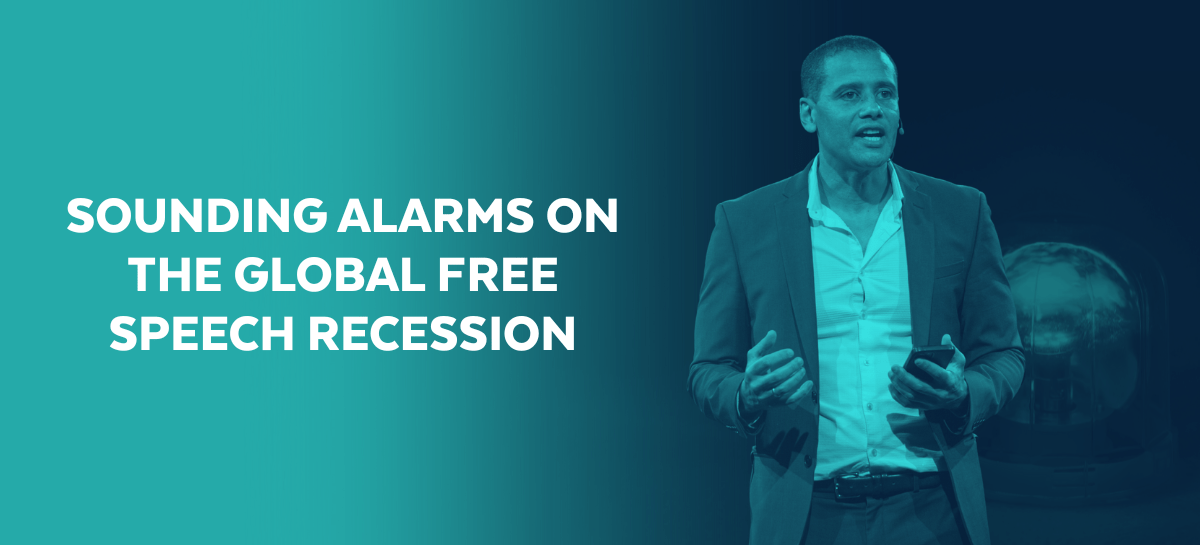
FoFS’s work this year underscored a core reality: the free speech recession is not confined to Europe or the United States. It is global—and accelerating.
In Latin America, FoFS highlighted how democratic institutions are increasingly embracing censorship in the name of protecting democracy itself. On The Bedrock Principle, Jacob Mchangama and Jeff Kosseff examined Brazil’s growing concentration of judicial power over online speech, warning that officials were misusing liberal philosophy and misrepresenting U.S. First Amendment principles to justify platform bans and sweeping content controls.
Jacob later spent a week in Brazil promoting the Portuguese edition of Free Speech: A History from Socrates to Social Media, engaging with journalists and civil society groups about how efforts to “save democracy” through speech suppression risk deepening polarization and undermining institutional trust across the region.
We’ve also been tracking the “Brussels Effect”— how Europe’s regulatory model is spreading globally, often stripped of its safeguards. We collaborated with CELE (Centro de Estudios en Libertad de Expresión) scholars to show how DSA-style laws are rapidly proliferating across Latin America, with legislatures borrowing Europe’s risk-based framework while abandoning core protections for due process, proportionality, and intermediary liability.
In Asia-Pacific countries from Malaysia to Nepal, we highlighted how governments are adopting EU-inspired online speech laws without the institutional checks needed to prevent abuse—turning platforms into tools of censorship and threatening journalists, activists, and political dissenters.
This work reflects FoFS’s global mission to trace how censorship models travel across borders, exposing the risks when democracies normalize speech control, and offering a clear warning that free expression cannot survive if its erosion in one region becomes the template for the rest of the world.
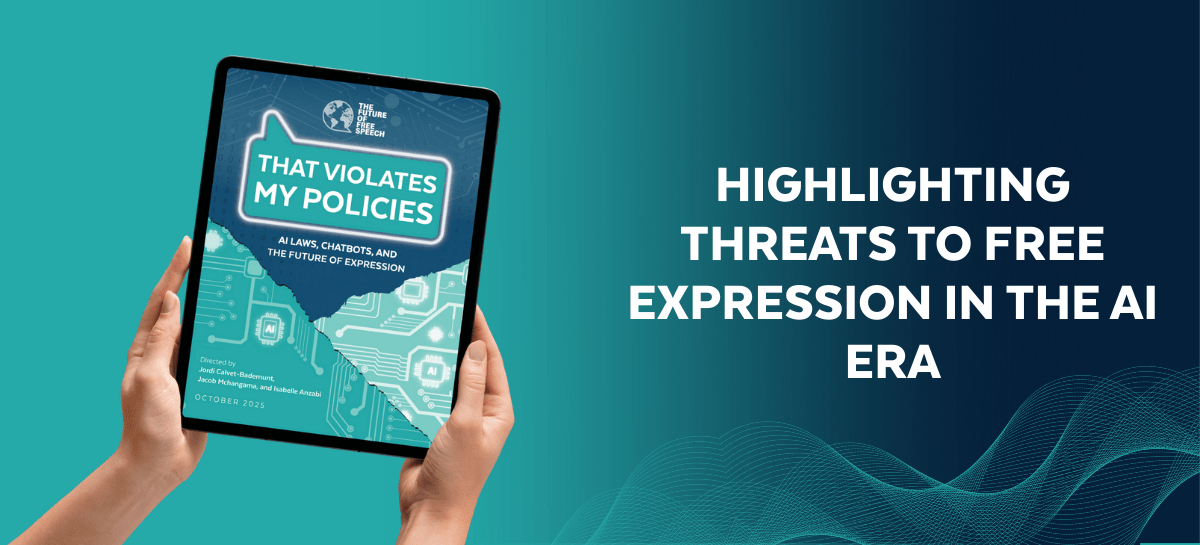
This year, we launched the first installment of our flagship report on artificial intelligence and free speech: “That Violates My Policies: AI Laws, Chatbots, and the Future of Expression” ranks six major jurisdictions on how their AI laws protect freedom of expression and tests eight of the world’s most popular chatbots on their willingness to engage with controversial but lawful prompts.
We find that company design choices and legislation are increasingly determining which ideas users can explore. Ultimately, we argue that AI companies and governments should embrace a clear, rights-based framework that protects users’ rights to access information.
And we have taken that message around the world.
In February, Jordi Calvet-Bademunt organized and moderated a panel at the 13th Annual RightsCon conference in Taipei, Taiwan, featuring academic and industry experts to discuss how trust and safety in generative AI platforms can respect both freedom of expression and safety concerns.
n May, Jacob Mchangama took to the stage at the Copenhagen Democracy Summit to discuss the difference between Creative AI and Intrusive AI and charted two paths we can take for the future: User Empowerment, where generative AI affirms free expression and the right to access information or Pre-emptive Safetyism that treats certain speech as harmful and seeks to block it at the source.
In December, Natalie Alkiviadou, Jordi Calvet-Bademunt, and Isabelle Anzabi organized a roundtable on generative AI and freedom of expression at Örebro University in Sweden. The event convened leading academics, regulators, companies, and civil society experts to explore how restrictions on AI content can transform democratic dialogue and influence the boundaries of acceptable speech.
Across major media outlets, FoFS scholars warned that growing political pressure on AI systems risks turning “neutrality” into a pretext for viewpoint control. In Tech Policy Press and MS NOW, Jacob Mchangama and Jordi Calvet-Bademunt examined parallel dynamics in Europe’s AI panic and U.S. demands for “neutral models,” where anxieties over “woke AI,” election interference, and political bias are driving demands for tighter controls on what AI systems can say.
FoFS scholars also highlighted constitutional dangers. Writing in the St. Louis Post-Dispatch, Ashkhen Kazaryan and Ashley Haek criticized efforts by state officials to pressure AI companies into reshaping chatbot outputs, warning that such “jawboning” violates the First Amendment and undermines users’ right to receive information.
At MS NOW, Jacob and Jordi further cautioned that this threat is compounded by a growing patchwork of state-level AI laws, many of them rushed and inconsistent, that could erode America’s traditionally speech-protective environment if left unchecked.
Together, these efforts reinforced a consistent message: protecting democracy in the age of generative AI requires resisting politicized speech controls and anchoring AI governance in clear, durable free speech principles.
Over the past year, we worked from the ground up to empower everyday people with practical tools to confront misinformation, disinformation, and hate with more speech—not censorship—and to help ensure that political and industry leaders i uphold essential digital policies and protections.
In mid-July, we hosted counterspeech trainings in Arabic, English, and Turkish. Natalie Alkiviadou joined experts from around the world to train free speech defenders on how speech itself can be the antidote to hatred, misinformation, and disinformation. By the end of the training, participants understood a critical truth: speech is the antidote, and censorship only deepens the crisis.
This success fueled the expansion of our work. We translated our online counterspeech and disinformation toolkits into Hebrew, Hindi, Urdu, and Turkish (forthcoming), bringing the total number of languages available to nine. By equipping people across the globe with actionable strategies to challenge harmful speech without resorting to censorship, we are fostering a shared understanding of freedom—and strengthening democracy at its foundation
In April, Ashkhen Kazaryan convened a First Amendment roundtable with the Tennessee General Assembly and led a constructive discussion on misinformation, AI-generated content, hate speech, and the role of government in protecting free speech. Focusing on current issues, constitutional safeguards, and potential policy approaches, Ashkhen brought free speech to the forefront of conversations about legal and ethical decision-making.
In November, we organized a session on a pilot content moderation prototype that enables administrators of platform groups, media outlets, and civil society organizations to filter hateful content through a responsive algorithm. The session was attended by civil society, academics, and tech industry representatives and served as an opportunity to test, discuss, and pilot the system together, as well as to gather valuable feedback and insights on its design and functionality.
Expanding our AI Rankings Report
In Year 2 of our AI report, we will examine AI policies in 5 additional countries and provide a cross-country comparison. Our analysis of AI models’ content policies will expand to include newer models and assess bias.
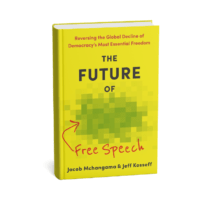
The Future of Free Speech: Reversing the Global Decline of Democracy’s Most Essential Freedom
Coming April 2026, The Future of Free Speech confronts a stark truth: the right to speak freely is under siege. Once celebrated as a cornerstone of democratic societies, free expression is now met with growing suspicion and retaliation across the globe. Jacob Mchangama and Jeff Kosseff present a panoramic view of how we arrived at this pivotal moment.
Launching Blueprints for Free Speech Project
Next year, we plan to launch a comparative initiative focused on the U.S. and democratic swing states Brazil, India, and South Africa that uses legal research, empirical analysis, and public education to help judges, lawmakers, and civil society protect essential speech rights—including press freedom, anonymous speech, platform openness, and anti-SLAPP measures.

Join Us at Next Year’s Summit
Next fall, we will co-host the 3rd annual Global Free Speech Summit with Vanderbilt University. To watch sessions from this year’s Summit, check out our YouTube page.
Stay tuned!
Download Our 2025 Year In Review
Sign Up for Our Newsletter to Stay Connected in 2025

